Pagine


Visualizzazione post con etichetta Design. Mostra tutti i post

lunedì 15 novembre 2010

An exhibit with buxom curves


Visiona II,
an environment by Verner Panton
for Bayer AG, 1970

In the context of the Cologne furniture fair in 1970 Bayer in cooperation with the Danish designer Verner Panton presented Visiona II, an almost breathtaking interior staging wallowing in colors and forms. The project presented motley colors and buxom curves. In fact some of the most famous  photographs shows a kind of interior cave made with soft and curved bulges in blue and red colour.

To explore Visiona II go on: http://www.apartmenttherapy.com/la/look/look-verner-pantons-visiona-2-076384

domenica 14 novembre 2010

Straight lines to advertise design objects

Op Art advertisement for Danese
Enzo Mari
published 1967

 
The impact of "Op" canvases was instant and dramatic. The dazzling, eye-catching visual effects of "Op" were useful to designers of logos, advertising graphics, fabrics and seemingly any two-dimensional surface which sought high impact in a fashionable idiom. These dramatic black and white patterns became ubiquitous.
In this graphic made for Danese, Enzo Mari proposes in an optical key his umbrella stand: it is drawn through straight black lines which are manipulated to communicate not only the silhouette of the object, but also its curved shape.

venerdì 12 novembre 2010

Straight and curved in light design


                         Arco, A. Castiglioni, Flos, 1962                  Luminator, A. Castiglioni, Flos, 1954

 
Two Castiglioni's lamps show that light designers like to experiment with both straight and curved shapes. In fact, by their nature, lamps can take various conformations, depending on the functional purpose and creativity of the designer.

mercoledì 10 novembre 2010

Design: straight.

One chair, by C. Grcic for Magis

Red and blue chair, by G. Rietveld


Mies chair, by Archizoom for Poltronova

Hill House chair, by C. R. Mackintosh

Superleggera, by G. Ponti for Cassina

Libreria Carlton, by E. Sottsass jr. for Memphis

domenica 7 novembre 2010

Exhibit: Space is curved or straight?


Present in Mario Merz from the beginning, the image of the cosmic spiral becomes the distinctive feature of his work, displaying the sequence of numbers discovered by the mathematician Leonardo Fibonacci and chosen by the artist to represent the natural processes that regulate growth. The spiral represents the relation between art, mathematics and cosmology.

The spiral was also the protagonist of one of his famous shows of 1990: "The space is curved or straight?". It was a total work created with iron, bundles of wood, glass, neon and newspapers and with it Mario Merz applied his conviction to incorporate all areas of a museum in his work, rather than simply to show his works in architectural space. The installation was flowing from outside to inside, from the museum at the square, creating a path along three hundred yards of charm that gave the impression which the nature invaded the museum.

Today designers experiment ... with the curved!

The curves expressing softness, comfort and sensuality. For this reason, designers are fascinated by the potential of the curved forms which, by their nature, are applicable to the design of chairs and armchairs, but also in other objects in the home.

And, chair-sculpture by Fabio Novembre for Cappellini, 2002


Krysalis, sofa by Karim Rashid for Felicerossi, 2005


Bookworm, library by Ron Arad for Kartell, 1994 


"Curved design" of the Sixties and Seventies

An overview of some curved objects that are symbols of design in the '60s and 70s

Djinn chair and stool, Oliver Mourgue, 1965

Bubble chair, Eero Aarnio, 1965

Eclipse lamp, Vico Magistretti, 1967

Safari seating system, Archizoom, 1967

Superonda, Archizoom, 1967

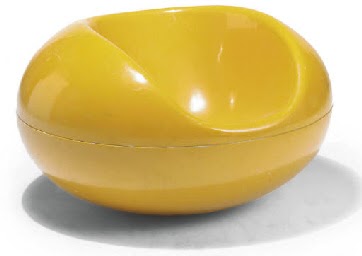
Pastilli chair, Eero Aarnio, 1968


Up, Gaetano Pesce, 1969

Tube chair, Joe Colombo, 1969


Living tower, Verner Panton, 1969

 Mouth, Studio 65, 1971

Ribbon chair, Gruppo G14, 1971