Pagine


giovedì 27 gennaio 2011

博客的描述,中文


我们的博客致力于一材料历史的角度去表现“直”和“弯”的不同意义。这一对形容词我们实际上是以不同角度来分析的:艺术和数学、文学和地理,历史和漫画,以及电影和广告、时尚。同时也用了充足的笔墨去展现有关这两个形容词的一系列的日用品和设计。
通过看我们的博客你可以看见我们周围的世界确实是直和弯的缩影。
看完我们的博客你会发现这两个形容词是和以下主题相联系的:善与恶、对与错、有序与混乱、自然与人造。从这些,我们可以找到覆盖这个博客的话题。

La description du blog en France


Ce blog essaye de raconter les différents sens qui ont été donnés aux termes "droit" et "courbe" dans l'histoire de la culture matérielle. Ce couple d'adjectifs est en effet analysé selon différents points de vue: de l'art aux mathématiques, de la littérature à la géographie et l'histoire jusqu'aux bandes dessinées, le cinéma, la publicité et la mode.
Une grande attention a aussi été donnée à toute une série d'objets d' utilisation quotidienne et de design qui mieux représentent ces deux adjectifs.
En visitant le blog, on peut voir le monde qui nous environne de façon droite ou courbe ,soit concrètement que métaphoriquement, étant donné que à la fin de la visite il est possible de relier les deux termes à quatre grands thèmes: le bien et le mal, le juste et le faux, le structuré et le chaotique, le naturel et l'artificiels. C'est à partir de ces thèmes qu'on peut retrouver les questions traitées dans le blog.

La descripción del blog en Espana

Este blog intenta contar a los diferentes significados que "recto" y "curvo" toman en la historia de la cultura material.
El par de adjetivos, de hecho, analiza desde distintas perspectivas: desde el arte a las matemáticas, la literatura, la geografía, la historia, las tiras cómicas, el cine, la publicidad y la moda. Suficiente tiempo se le dio también una serie de objetos cotidianos y los diseños que mejor representan los dos adjetivos.
Al visitar el blog se puede ver el mundo que nos rodea es en realidad y metafóricamente recto y curvo. Para terminar la visita se puede conectar al par de adjetivos a cuatro temas principales: el bien y el mal, lo correcto e incorrecto, lo estructurado y  lo caótico, lo natural y  lo artificial. De ellos, de hecho, podemos encontrarlos temas tratados en el blog.

The description of the blog in England

This blog tries to tell the different meanings that "straight" and "curved" take in the history of material culture.
The couple of adjectives, in fact, is analyzed through different perspectives: from art to math, from literature to geography, from the history of comic strips and from film to advertising and fashion. Ample time was also given to a  series of everyday objects and designs that best represent the two adjectives.
By visiting the blog you can see the world around us is actually and metaphorically straight and curved. In the end of the visit the pair of adjectives can be connected to four major themes: good and evil, right and wrong, structured and chaotic, natural and artificial. From them, in fact, we can find the topics covered in the blog.

La descrizione del blog in Italia

Questo blog cerca di raccontare i diversi significati che “dritto” e “curvo” assumono nella storia della cultura materiale.
La coppia di aggettivi, infatti, è analizzata attraverso diversi punti di vista: dall’arte alla matematica, dalla letteratura alla geografia, dalla storia ai fumetti, fino ai film, alle pubblicità e alla moda. Ampio spazio è stato dato anche a tutta quella serie di oggetti di uso quotidiano e di design che meglio rappresentano i due aggettivi.
Visitando il blog si può osservare il mondo che ci circonda in modo dritto e curvo sia concretamente che metaforicamente, poiché a conclusione della visita è possibile collegare la coppia di aggettivi a quattro importanti tematiche: bene e male, giusto e sbagliato, strutturato e caotico, naturale e artificiale. A partire da esse, infatti, possiamo ritrovare gli argomenti trattati all’interno del blog.

sabato 22 gennaio 2011

Conceptual Map


Our conceptual map try to show the different topics of the blog "Straight & Curved".
We have observed the world around us in a "straight" and "curved" way and we have came  to four main concepts that can be considered as the central thread of the posts published.

The search of a straight-line mechanism

During the centuries, the problem to describe a straight line was one that tickled the fancies of mathematicians, of ingenious mechanics, and of gentlemanly dabblers in ideas. Sir Alfred Bray Kempe was a mathematician  who discovered (in 1877) new straight line linkages and published his influential lectures on the subject.


You can read his theories in the book "How to draw a straight line" available on line by clicking here

The Universe is curved?


For centuries philosophy has questioned the concept of the universe. As regards the form, the Pythagoreans conceived the universe as a sphere. This view was later taken by Copernicus and Kepler in 1500. Just Kepler was convinced that the scheme of the universe could be expressed in numerical and geometric relationships. But Albert Einstein's theory is more revolutionary in this field, since he states that the universe is finite and curved.
As for the word curved he explains that "A person from the exceptional view, looking straight ahead, should be able to see your neck." Suppose that we are all men in one dimension and to live in a universe in a single dimension. Each of us, in this case, it would be only a dash. Our universe, then, would simply be a straight line? No, because the universe is not a straight line but a circle. If one of us would walk all would return to the starting point. The universe, therefore, is not infinite, but finite, and it is finished because it is curved. The space, therefore, is curved by the presence of mass. The curvature of the universe depends on its average expansion rate and the average density of matter it contains. According to this theory, the curvature of the universe is completely determined by its matter-energy content and determines the fate of the cosmos. The General Theory of Relativity of Albert Einstein (1916) has, therefore, represented a major turning point, but the most progress in understanding the general structure of the universe and its evolution have occurred in the last two decades of the last century, thanks to new knowledge about the intimate structure of matter. These discoveries allowed a  philosophical (but also scientific) description of universe.

martedì 16 novembre 2010

Two advertising styles: "straight font" vs "curved font"

Art Nouveau advertising posters 


Wiener Werkstatte font in some posters of the group


Dynamic, undulating, and flowing lines in a syncopated rhythm, are found throughout the Art Nouveau graphics (advertisements, posters e font). All items, also the lettering, were pictured with curved flowing lines that were rarely symmetrical.
Instead Weiner Werkstatte group was obsessed with squares and grids, as is evident in these posters. The appearance of the letters and articles was unified by elements such as straight lines (orizontal, vertical and oblique) and decorative square.

lunedì 15 novembre 2010

An exhibit with buxom curves


Visiona II,
an environment by Verner Panton
for Bayer AG, 1970

In the context of the Cologne furniture fair in 1970 Bayer in cooperation with the Danish designer Verner Panton presented Visiona II, an almost breathtaking interior staging wallowing in colors and forms. The project presented motley colors and buxom curves. In fact some of the most famous  photographs shows a kind of interior cave made with soft and curved bulges in blue and red colour.

To explore Visiona II go on: http://www.apartmenttherapy.com/la/look/look-verner-pantons-visiona-2-076384

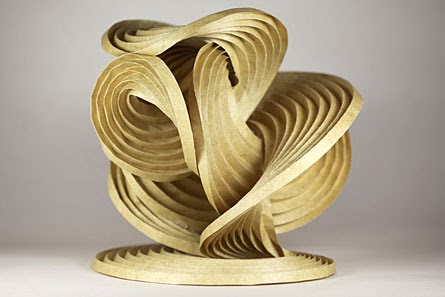
As some octagons become a curved sculpture


Erik and Martin Demaine created “Natural Cycles” as part of their exploration of curved folds in origami. They took a two-foot by two-foot piece of paper and cut the corners off to form an octagon. Then they creased concentric octagons within it with alternating folds. They dampened the paper, pressed all the folds at once, and put the edges of the paper in the shape of the cube’s Hamilton cycle. The combination of straight edges and straight folds formed a beautiful curved surface.

domenica 14 novembre 2010

Straight lines to advertise design objects

Op Art advertisement for Danese
Enzo Mari
published 1967

 
The impact of "Op" canvases was instant and dramatic. The dazzling, eye-catching visual effects of "Op" were useful to designers of logos, advertising graphics, fabrics and seemingly any two-dimensional surface which sought high impact in a fashionable idiom. These dramatic black and white patterns became ubiquitous.
In this graphic made for Danese, Enzo Mari proposes in an optical key his umbrella stand: it is drawn through straight black lines which are manipulated to communicate not only the silhouette of the object, but also its curved shape.

Corset: a garmet ... straight and curved!

The history of the corset shows us how this garment is designed by following and emphasizing as much as possible the female body; so it has sinuous and curved shapes. But, given the function to tighten the waist, sometimes it also presents straight and rigid parts. To better understand these are two types of corset.


Hourglass Corset
This is a drawing of the hourglass or "curvaceous corset". One of the major features of the hourglass style is that it provides more room for the lower ribs and is easier to reduce your waist-line quickly. This allows for optimum waist reduction with the minimum of effort.


Straight-Front or S-Curve Corset
This is the Straight-Front or S-Curve corset. In 1900 Madame Gaches-Sarraute, a Parisian corsetiere who studied medicine, designed the Straight-Front or S-Curve corset. This style of corset was designed to alleviate many of the stresses on the abdomen created by a corset.  It was a type of corset worn from the start of the nineteenth century until around 1907 and its name is derived from the very rigid, straight busk that was used down the center of the front. It was the most complex shape of corset ever made, because consisting of up to 48 intricately curved and shaped pieces. 

Curved shapes ... in fashion


Levi’s has listened to women everywhere and created a collection of jeans perfectly cut to fit curves. Their curved shape (based on a textile system developed by the company) offers three custom models based on women's shape and proportions. Through a worldwide research, Levi’s identified three primary body types: Slight Curve, Demi Curve, Bold Curve.

sabato 13 novembre 2010

Tube: how to bend a straight and industrial semifinished product

Tube bending is a process to create curves on thin-walled tubes also. It occurs on folding machines that can be fully automated and make bends in all directions, even with variable radius. This technology includes several variants.


Rotary Draw Bending
When rotary draw bending is applied, the tube is fastened between the bend die and the clamp die. The rotation of both tools around the bending axis bends the tube to the radius of the bend die. The pressure die (slide piece) serves the purpose of receiving the radial stress, which is generated during the forming process, and supports the straight tube end from outside. If a mandrel and wiper die are additionally applied (mandrel bending), a high quality work piece can be achieved even with thin-walled pipes and tight bending radii.

Compression Bending
It is similar to rotary draw bending. This bending method is carried out with a sliding carriage and a stationary bend die, between which the tube is clamped. The sliding carriage, which rotates around the radius block, bends the tube to the radius of the bend die.

Ram Bending (Press Bending)
When ram bending is applied, a radiused bending tool is pressed against two counter-rollers, either manually or by means of hydraulics. This motion forces the tube inserted between the radius block and the counter-rollers to bend around the radius. The tube cannot be supported from within, therefore this method is suitable for thick-walled tubes and large bending radii only.

3-roll Bending
This process is also used for producing work pieces with large bending radii. The method is similar to the ram bending method, but the working cylinder and the two stationary counter-rollers rotate, thus forming the bend

If you want to see a tube bending click here

Straight and curved in "scientific" stamps


These are some stamps related to various branches of science.
On them are depicted straight lines, curves and spirals typical
of the world of mathemayics, physics and chemistry.

Two mathematicians and their curves on stamps


Gottfried Wilhelm von Leibniz (1646-1716): mathematician, scientist, philosopher.
Coins the term "function": it is necessary to identify the various quantities associated to a curve, including its value, the slope and the perpendicular at one point.

Friedrich Wilhelm Bessel (1784-1846): mathematician, astronomer.
He was the first to determine the distance of a star by measuring the parallax of 61 Cygni in 1838. With his precise observations could categorize the locations of more than 50000 stars and then he introduced mathematical functions now know by his name.

Stamps with curved objects and concepts


venerdì 12 novembre 2010

Straight and curved in light design


                         Arco, A. Castiglioni, Flos, 1962                  Luminator, A. Castiglioni, Flos, 1954

 
Two Castiglioni's lamps show that light designers like to experiment with both straight and curved shapes. In fact, by their nature, lamps can take various conformations, depending on the functional purpose and creativity of the designer.