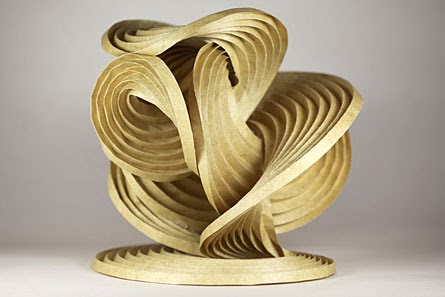
Erik and Martin Demaine created “Natural Cycles” as part of their exploration of curved folds in origami. They took a two-foot by two-foot piece of paper and cut the corners off to form an octagon. Then they creased concentric octagons within it with alternating folds. They dampened the paper, pressed all the folds at once, and put the edges of the paper in the shape of the cube’s Hamilton cycle. The combination of straight edges and straight folds formed a beautiful curved surface.
Visualizzazione post con etichetta Arts. Mostra tutti i post
lunedì 15 novembre 2010
domenica 14 novembre 2010
Straight lines to advertise design objects
Op Art advertisement for Danese
Enzo Mari
published 1967
The impact of "Op" canvases was instant and dramatic. The dazzling, eye-catching visual effects of "Op" were useful to designers of logos, advertising graphics, fabrics and seemingly any two-dimensional surface which sought high impact in a fashionable idiom. These dramatic black and white patterns became ubiquitous.
In this graphic made for Danese, Enzo Mari proposes in an optical key his umbrella stand: it is drawn through straight black lines which are manipulated to communicate not only the silhouette of the object, but also its curved shape.
mercoledì 10 novembre 2010
The concept of straight in the Futurism
domenica 7 novembre 2010
Exhibit: Space is curved or straight?
Present in Mario Merz from the beginning, the image of the cosmic spiral becomes the distinctive feature of his work, displaying the sequence of numbers discovered by the mathematician Leonardo Fibonacci and chosen by the artist to represent the natural processes that regulate growth. The spiral represents the relation between art, mathematics and cosmology.
The spiral was also the protagonist of one of his famous shows of 1990: "The space is curved or straight?". It was a total work created with iron, bundles of wood, glass, neon and newspapers and with it Mario Merz applied his conviction to incorporate all areas of a museum in his work, rather than simply to show his works in architectural space. The installation was flowing from outside to inside, from the museum at the square, creating a path along three hundred yards of charm that gave the impression which the nature invaded the museum.
A straight and curved ... artist!
Frank Stella is the most significant representative of the Minimal Art, evolved in the 60s and 70s.
The most famous production of him consists of a series of monochromatic paintings or limited color scale, based on the strip. Then, in the late 60s, Stella also introduces the curves in his work.
" My painting are based on the fact that within them there is only what you can see"
(Frank Stella)
Sunset Beach, Sketch
flourescent and plain alkyd painting, 1967
Flin Flon III
synthetic painting on canvas, 1969
Madinat as-Salam I
polymer and flourescent paint on canvas, 1970
domenica 31 ottobre 2010
The dynamism of the curved shapes in the sculpture
Forme uniche nella continuità dello spazio, U. Boccioni, 1913
"It is achieved through the intuitive search for the one single form
which produces continuity in space."
(Umberto Boccioni, 1882-1916)
"It is achieved through the intuitive search for the one single form
which produces continuity in space."
(Umberto Boccioni, 1882-1916)
Boccioni puts speed and force into sculptural form, as a search for 'simultaneity', and for a 'synthesis' between what is remembered and what is seen. The figure strides forward, surpassing the limits of the body, its lines ripple outward in curving and streamlined flags, as if molded by the aerodynamic of its passing. Boccioni implies not only that his tightly compressed subject is so dynamic that it must burst its four-sided confines, but that it is a fragment of a constantly changing visual experience. It reflects a desire to go beyond the world of machines and, perhaps beyond ordinary senses
Straight and curved in the pictorial symbols
Il bacio, G. Klimt
The work is based on a classic pyramid scheme and it is characterized by a complicated network of contrasts between straight and curved lines.
Lines must express feminine softness and masculine rigor, spiritualism and concrete nature, eroticism and asceticism, grace and force, pliability and toughness. Straight lines and square shapes decorate the dress of the man to emphasize his calm and force, while the dress of the woman is rich in floral curved to represent the delicacy and fragility of woman.
sabato 30 ottobre 2010
The curved line in visual art
The curved line appears first in architecture and only later in the visual arts. In particular, the Baroque painting is characterized by swirling curvilinear trends that make it dramatically expressive, just think of Caravaggio, the Carracci, Rembrandt, Lanfranco, Velazquez and many others. The English painter William Hogarth (1697-1764) creates a composition like a S called "line of beauty" and find the secret of harmony in the double curve.
In the nineteenth century William Morris (1834-1896), founder of British design movement "Arts & Crafts", rediscovers the curved line through the revival of Gothic, in a style that involves the fine arts, applied arts and crafts.This is the century of the artistic movement called Art Nouveau in France, Secession in Austria, Jugendstil in Germany, Liberty in Italy, Modernism in Spain.
In general, it can be said that the curved line is suitable to represent the natural elements in a stylized way, as in the Liberty, which adopts a curved line known as "whiplash," but it is also well suited to suggest the idea of spiritualistic nature force so as in the Symbolism.
Among the modern artists, Paul Klee uses the curved line in many of his designs "childish" in which the curve grows at infinity; Gustav Klimt instead proposes flat and curved shapes, stylized as arabesques, elegant dancers, and still lifes. Oskar Kokoschka, a member of the Secession, favors a curved line to better express his troubled relationship with the life suffered, while Edvard Munch uses the complex curved line of Art Nouveau to express his poetic anxiety. In Italy Gaetano Previati, one of the greatest artists of the Liberty, use a wavy and serpentine line.
Finally, Sol Lewitt, famous for its murals with bands straight, vertical and horizontal, feels the need to introduce the curved line in his last wall drawings to expand its discourse on art as a metaphor for the complexity of life.
The straight line in visual art
Straight line in the Neoclassical period means a rejection of the earlier dramatic curves of the Baroque and it is used to obtain a formal language as simple and essential.
In the Modern Art the use of the straight line expresses essentially the same needs: the minimalist American culture, aimed at a rigorous geometric reduction, invented the skyscraper as a symbol of a pragmatic society that goes straight to the point; in the European culture the straight line has more intellectual meanings, because it is the sign of spiritualism. For example, Piet Mondrian, strict Calvinist, use straight lines in his abstract Neoplastic style creating grid systems with straight black lines, looking for a geometric balance.
The Futurism in Italy suggests a straight line "living, breathing" of "naked severity" that becomes dynamic through an internal force as vibrant as the string of an instrument.
The Annunciation by Piero della Francesca shows the use of central perspective
in the Renaissance. The construction work is based on straight lines
that converge into a single vanishing point.
Straight and curved lines
The lines are important elements for a visual reading, because their performance shows the intent of the author and send the communicative message clearly and immediately, especially the psychological and emotional.
The straight line is a symbol of mind control, to simplicity of expression and mathematical and geometrical order.
The curved line suggests the idea of a free and unified movement, but not uniform; it is a symbol of harmony and protection.
The straight line is a symbol of mind control, to simplicity of expression and mathematical and geometrical order.
The curved line suggests the idea of a free and unified movement, but not uniform; it is a symbol of harmony and protection.
giovedì 21 ottobre 2010
Concept of right and curved in the art
"L’elemento armonico generale di una composizione può consistere in alcuni complessi spinti fino al massimo grado del contrasto. Questi contrasti possono avere un carattere addirittura disarmonico, e tuttavia, se usati in modo appropriato, influiranno in modo non negativo bensì positivo sull’armonia complessiva ed eleveranno l’opera al massimo livello armonico"
Punto, linea, superficie, W. Kandinsky, 1910, acquerello
(Vassilij Kandinskij)
Punto, linea, superficie, W. Kandinsky, 1910, acquerello
A painting with curves
Notte stellata,V .Van Gogh, 1889, Museum of Modern Art, New York
"Sto dipingendo l'infinito"
(Vincent Van Gogh, 1853-1890)
A painting with straight lines
Composition with with Red, Blue and Yellow, P. Mondrian, 1930, oil of canvas.
Reducing his color scheme to primary hues in “Composition with Red Blue Yellow,” Piet Mondrian (1872 – 1944) followed the shape of the canvas with deceptively simple black lines and blocks of color to create maximum impact in his Neoplastic style.
Iscriviti a:
Post (Atom)